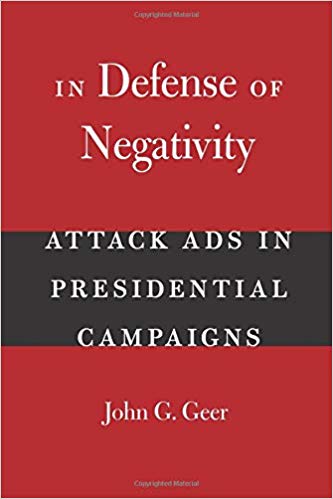
In Defense of Negativity: Attack Ads in Presidential Campaigns by John Geer
“The election of 1960 stands out as a contest where neither candidate was very negative about the other’s personality. Of all of Nixon’s references to personal characteristics in 1960, only 7% were personal attacks against Kennedy. Among Kennedy’s references to traits, just 16% were critical of Nixon. 15 From 1964 to 1988 there was no clear trend, with the average rate of attack between the two major party nominees ranging from 20% to 36%. In 1968, for example, 26% of Humphrey’s references to character were attacks on Nixon. Eight years later, 21% of both Carter and Ford trait appeals were negative. Of Ronald Reagan’s discussion of personal characteristics, 34% were attacks on Carter. Starting in 1992, this measure of negativity starts to move upward. The Bush reelection campaign stands out in this regard. In 1992, 75% of all of the elder Bush’s references to traits were attacks on Clinton’s character. This is by far the all time high under the period of study. The next closest was George W. Bush’s attacks on Al Gore’s character, which stood at 57% of all trait appeals.”1
In his book In Defense of Negativity, John Geer looks at the rise of negativity in presidential campaigning, including the use of attack ads, from 1960 to 2004. Geer analyzes the amount of advertising that was conducted by campaigns during this period as well as the sorts of ads the candidates ran. The featured passage helps to illustrate the rapid growth the attack ad genre has experienced since the 1990s. As Geer says, between 1964 and 1988, attack ads typically only made up a quarter to a third of all political ads. However, by the 1992 election, a far higher percentage of campaign ads included attacks on character traits. This was an abrupt shift in the way campaigns ran ads and one that would prove to be a popular choice up to the present day.
- Geer, John G.. In Defense of Negativity : Attack Ads in Presidential Campaigns. Chicago: University of Chicago Press, 2006. Accessed December 11, 2019. ProQuest Ebook Central.
 HI 231- Attack Ads in Presidential Campaigns