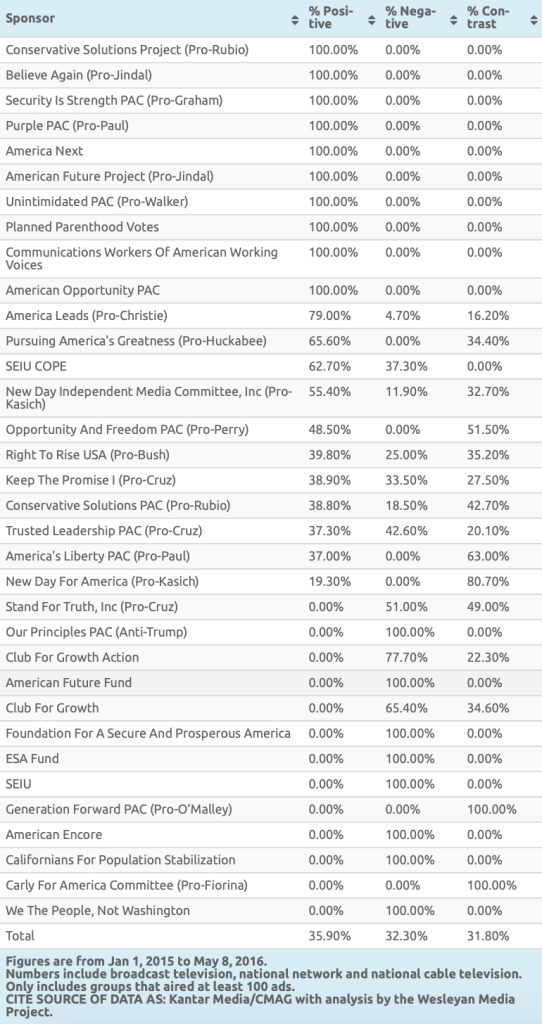
This chart breaks down the tone of ads produced by 34 major political action groups during the 2016 election.4 The first thing to notice about this chart is the sheer number of groups producing ads. There are twice as many groups advertising as there are candidates in the race. Additionally, while the candidates aired largely positive ads, only 36% of all ads produced by groups were positive while some 32% were strictly negative. Eight groups, including Our Principles PAC, American Future Fund, and American Encore, aired only negative attack ads. It is interesting to note that many of the groups running exclusively negative ads were often Republican support groups airing ads attacking Donald Trump.
The large presence of political action groups in the election advertising landscape is no coincidence and likely had a large impact on voter opinions. In 2014, Conor Dowling published a study in the American Journal of Political Science assessing the influence of negative advertising in elections. After testing ads on multiple groups and polling their results, he found that “candidate-sponsored negative ads result in more backlash against the attacking candidate compared to group-sponsored ads and, to a lesser extent, party-sponsored ads.”5 The report goes on to say that a candidate’s campaign could benefit the most by having a political action group do the attacking, rather than the party they are with. To summarize, candidates do not want to have their name attached to an ad attacking a rival as it may reflect badly on them. It is safer to let a group run a negative ad without any explicit connection to a particular candidate or party.
4. Wesleyan Media Project. “Advertising Volume Up 122% Over 2012 Levels; Spending in Presidential Race Over $400 Million.” Wesleyan Media Project, May 12, 2016. http://mediaproject.wesleyan.edu/ad-spending-over-400-million/.
5. Dowling, Conor M., and Amber Wichowsky. “Attacks without Consequence? Candidates, Parties, Groups, and the Changing Face of Negative Advertising.” American Journal of Political Science59, no. 1 (March 12, 2014): 19–36. https://doi.org/10.1111/ajps.12094.
 HI 231- Attack Ads in Presidential Campaigns